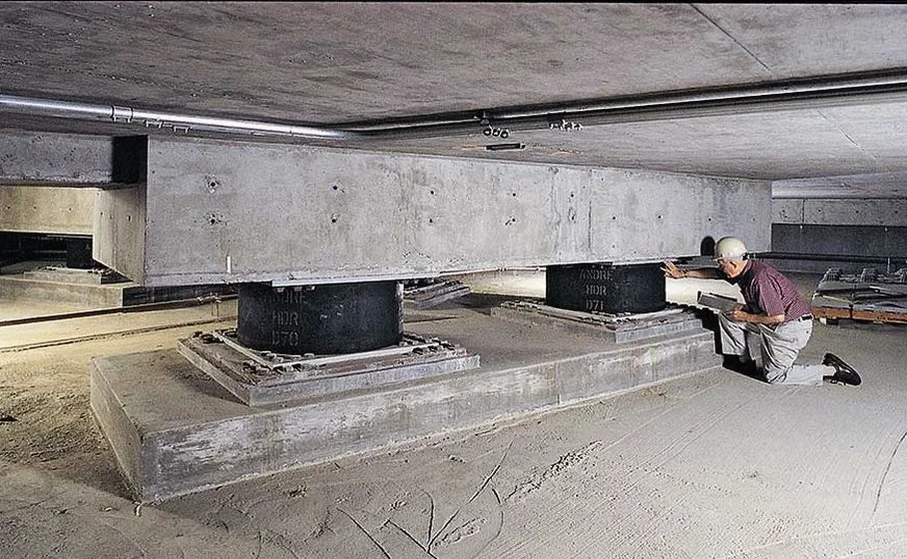
The semi-arid climate and deep alluvial deposits of the Murray Basin present a specific geotechnical challenge for structural engineers working in Mildura. While the region is not classified as a high-seismicity zone like parts of New Zealand or Indonesia, the amplification effects of the deep Woorinen Formation sands and the underlying Renmark Group clays demand a careful evaluation of site class. We have observed that standard fixed-base designs in this area can inadvertently produce higher floor accelerations than predicted when the soil-structure interaction period lengthens due to the soft clay layers at depth. Base isolation seismic design in Mildura requires a thorough understanding of AS 1170.4-2007 site-specific response spectra, particularly when the probability factor (kp) and the hazard factor (Z) combine with a deep soil profile. The goal is not just compliance with the National Construction Code, but ensuring that critical infrastructureâsuch as the Mildura Base Public Hospital or food processing facilitiesâremains operational after a seismic event. Our approach involves a detailed ground motion characterization, complemented by a seismic microzonation study when the siteâs geotechnical variability suggests that a single spectrum is insufficient to capture the basin edge effects common near the Murray River escarpment.
Decoupling a structure from the Murray Basinâs deep soil amplification can reduce base shear demand by over 60% when the isolation period is properly tuned to the site-specific response spectrum.
Methodology and scope
A common mistake we encounter in Mildura is the assumption that AS 1170.4 Site Class De (deep soil) automatically justifies a conventional fixed-base design without verifying the displacement compatibility of non-structural elements. This oversight can lead to brittle failure of partition walls and suspended ceilings even under a service-level earthquake. A properly configured base isolation system decouples the superstructure from the ground, increasing the fundamental period of the building to a range where spectral accelerations are significantly reduced. For a typical five-story structure on the Mildura riverine plain, shifting the period from 0.6 seconds to 2.5 seconds can cut the base shear demand by up to 65%, depending on the isolator properties. We design both high-damping rubber bearings (HDRB) and friction pendulum systems (FPS), selecting the lead core diameter, rubber shear modulus, and concave plate radius to match the design basis earthquake (DBE) and the maximum considered earthquake (MCE) displacements. The analysis follows the iterative effective stiffness and equivalent viscous damping procedure outlined in ASCE 7-16, adapted to the Australian seismic hazard model. Each isolator unit is modeled with bilinear hysteresis in ETABS or SAP2000, verifying that the maximum displacement under MCE does not exceed the manufacturerâs certified capacity and that the moat wall provides an adequate clearance of at least 1.2 times the peak displacement.
Local considerations
In Mildura, many buildings constructed in the 1970s and 1980s predate the modern seismic detailing requirements of AS 3600:2018 and rely on unreinforced masonry or gravity-load-designed concrete frames. We frequently see that the soil profile at these sites, often classified as Ce or De, amplifies long-period ground motion components that can resonate with the natural period of these older, rigid structures. A base isolation retrofit is not always straightforward in these cases, but the alternativeâa brittle shear failure in the ground-story columns during a moderate eventâcarries a far higher consequence. The risk is compounded by the presence of liquefiable sand lenses within the Woorinen Formation, which can cause differential settlement beneath the isolation plane if not treated with stone columns or rigid inclusions. Our risk assessment quantifies the probability of collapse (Pc) and the mean annual frequency of exceedance for the isolation systemâs displacement capacity, ensuring that the residual risk of the isolated structure is below the tolerable threshold defined in the Australian Earthquake Engineering Society (AEES) guidelines.
Frequently asked questions
What is the cost range for a base isolation design project in Mildura?
For a mid-rise commercial building with a footprint of 800 to 1,500 square meters, the full engineering design package, including nonlinear time-history analysis and peer review coordination, typically falls between AU$5,720 and AU$11,800. The final figure depends on the number of required ground motion pairs, the complexity of the isolation plane geometry, and the level of prototype testing specified.
How does the deep soil profile in Mildura affect the isolation design?
The deep Woorinen Formation sands and Renmark Group clays beneath Mildura create a Site Class Ce or De profile that amplifies spectral accelerations at periods between 0.5 and 1.5 seconds. This amplification is captured in the site-specific response spectrum. By shifting the structureâs effective period to 2.5-3.0 seconds through base isolation, we move the response to a range where the spectral ordinate is significantly lower, effectively bypassing the basin amplification peak.
Can existing buildings in Mildura be retrofitted with base isolators?
Yes, retrofitting is feasible but requires a detailed structural audit of the existing column grid and foundation capacity. The process involves jacking the superstructure, cutting the columns at the isolation plane, and installing the isolators on reinforced plinths. For buildings with unreinforced masonry, a supplementary grouting program to consolidate the walls prior to jacking is often necessary to prevent cracking during the lift.
What performance level can we expect under the Maximum Considered Earthquake?
Under the MCE, an isolated structure designed to AS 1170.4 and ASCE 7-16 Chapter 17 should achieve a Life Safety performance level, meaning the structure will not collapse and occupants can evacuate safely. The superstructure is expected to remain essentially elastic, with damage confined to replaceable isolator components and ductile moat cover details. The probability of collapse is reduced to well below 1% in 50 years.
What geotechnical investigations are required before starting the isolation design?
We require a comprehensive investigation including SPT boreholes to 30 meters depth to identify the shear wave velocity profile (Vs), MASW testing to constrain the Vs30 for site classification, and resonant column or cyclic triaxial tests on undisturbed samples from the bearing stratum to determine the strain-dependent shear modulus reduction and damping curves of the Mildura clays. This data is essential to calibrate the site response model in DEEPSOIL or equivalent software.