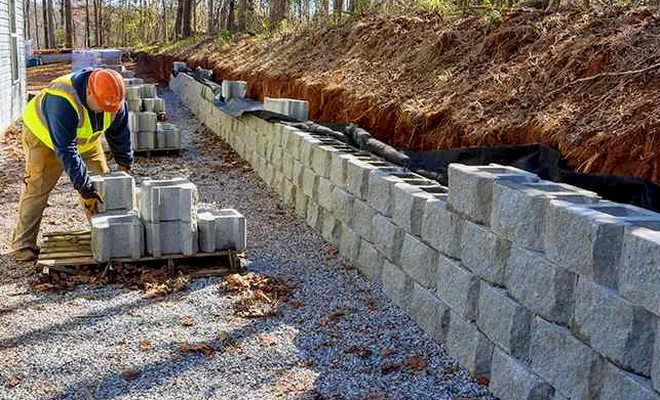
A Caterpillar 320 excavator breaks ground near the Murray River levee, exposing a profile that shifts from dry sandy loam at the surface to dense, expansive clay at three metres. In Mildura, retaining wall design must reconcile the region's semi-arid climate with the complex alluvial stratigraphy of the Murray-Darling Basin. The engineering team maps the transition zone between the Woorinen Formation and the Coonambidgal clays before a single reinforcement bar is specified, because wall performance here depends on understanding how these layers respond to irrigation seepage and seasonal drying cycles. Wall types vary from cantilever systems in the sandy rises around Irymple to gravity block walls in the heavier clays of Merbein, each requiring a site-specific geotechnical profile to define earth pressure distributions that generic charts cannot capture.
In Mildura's Coonambidgal clays, a retaining wall without a properly designed drainage system is just a temporary structure waiting for the next irrigation cycle.
Methodology and scope
Mildura's expansion through the Chaffey irrigation scheme in the 1880s fundamentally altered the local groundwater regime, and that legacy shapes every retaining wall project today. The original channels and drainage networks created perched water tables that fluctuate dramatically between the dry summer months and the winter irrigation season, imposing hydrostatic loads that were never considered when many of the older residential cut slopes were formed. Modern retaining wall design under AS 4678 addresses this through comprehensive drainage specification: granular backfill envelopes, geotextile filter layers, and weep-hole arrays sized for the silt content typical of Mildura's Parilla Sand unit. The design team also evaluates the swelling potential of the underlying Blanchetown Clay, which can generate lateral pressures exceeding active earth conditions if moisture is allowed to accumulate behind the wall face.
Frequently asked questions
What is the typical cost range for a retaining wall design in Mildura?
Retaining wall design fees in Mildura generally range from AU$1,690 to AU$5,650 depending on wall height, complexity of the soil profile, and whether the project requires anchored systems or simpler gravity designs. A standard residential cut wall under 1.5 metres typically falls at the lower end, while commercial walls exceeding 3 metres with drainage design and council documentation requirements move toward the upper range.
Does Mildura's clay soil require special retaining wall design considerations?
Yes. The Blanchetown Clay and Coonambidgal Clay units common around Mildura exhibit moderate to high swell potential, with measured pressures between 120 and 320 kPa. The design must include a drainage system that prevents moisture accumulation behind the wall, and the structural design should account for the possibility that lateral earth pressures may approach at-rest conditions rather than active conditions if the clay swells against the backfill.
Which Australian standards govern retaining wall design in this region?
AS 4678:2002 is the primary standard for earth-retaining structures in Australia. Site investigation follows AS 1726:2017, structural loading is governed by the AS/NZS 1170 series, and concrete or masonry components reference AS 3600:2018 or AS 3700:2018 respectively. The design also considers the seismic hazard factor Z=0.09 for the Mildura region as defined in AS 1170.4.
How long does the design and approval process take for a retaining wall in Mildura?
A standard retaining wall design package, including site investigation, laboratory testing of foundation soils, structural calculations, and preparation of construction drawings, typically takes three to four weeks from commission to delivery. Projects requiring additional council review or those located within the Murray River floodplain overlay may extend the timeline by an additional two weeks for regulatory coordination.