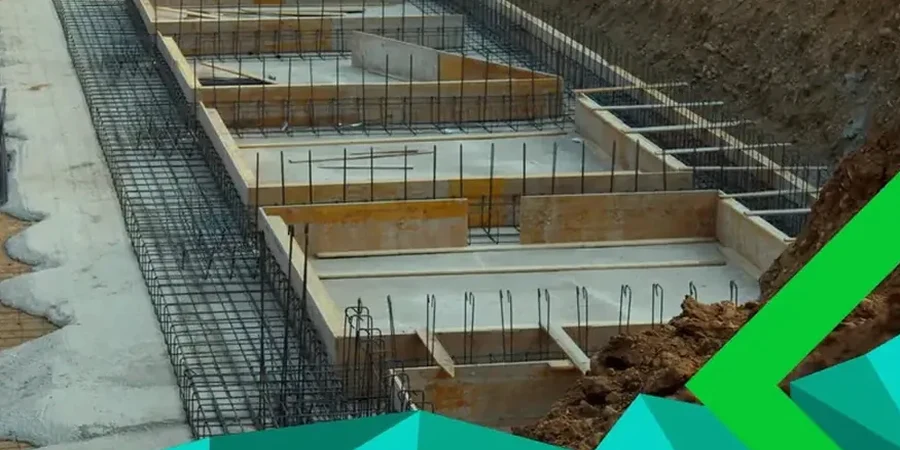
Mildura presents a geotechnical puzzle that standard foundation tables rarely solve. The surface layer across much of the region consists of wind-deposited Mallee sand, underlain at variable depth by the Blanchetown Clay and the older Parilla Sand formation. What works near the riverfront often fails three blocks inland where the clay rises closer to grade. Designing a shallow foundation here means reconciling AS 2870 site classification with actual bearing response, especially on Class M and H1 sites where reactive clay movement governs long-term slab performance. The team integrates borehole data and laboratory consolidation curves to produce a design that accounts for both short-term bearing capacity and seasonal moisture-driven heave. When sand lenses complicate the profile, we run parallel CPT testing to map the transition between granular and cohesive strata without losing resolution.
In Mildura, effective shallow foundation design depends less on bearing capacity than on controlling differential movement across reactive clay profiles.
Methodology and scope
A recent warehouse extension on Benetook Avenue illustrates the local challenge. The geotechnical investigation revealed 1.2 m of loose aeolian sand over medium-stiff clay, with groundwater at 3.8 m during summer monitoring. The structural engineer initially proposed a standard stiffened raft, but settlement differentials under the racking loads would have exceeded the 20 mm tolerance specified in AS 2870. Our shallow foundation design recalibrated the raft geometry with deepened edge beams and a compacted sand pad to bridge the soft clay lens. This approach cut the predicted angular distortion to under 1/500 while avoiding the cost of deep piling: bearing pressure was verified at 120 kPa after pad compaction, confirmed by plate load testing. In Mildura's semi-arid climate the soil moisture profile fluctuates sharply between irrigation season and dry summer, so the design also included a perimeter moisture control zone to limit edge heave. The solution stayed within the shallow foundation scope while addressing the three-way interaction between sand drainage, clay reactivity, and structural stiffness.
Frequently asked questions
How does AS 2870 site classification affect shallow foundation design in Mildura?
The classification (M, H1, H2) determines the characteristic surface movement (ys) the slab must accommodate. In Mildura, the Blanchetown Clay drives most H-class designations. An M-class site expects less than 20 mm of differential movement and can use a standard waffle raft. H1 and H2 sites require deeper edge beams, closer articulation spacing, and sometimes a sand pad to decouple the slab from the reactive clay. Site classification relies on Atterberg limits, suction measurements, and the depth to the clay layer, all interpreted within the AS 2870 framework.
What is the typical cost range for a shallow foundation design package in Mildura?
Shallow foundation design for a standard residential or light commercial project in Mildura typically falls between AU$3,050 and AU$5,070. The final figure depends on the number of boreholes required, the complexity of the soil profile, and whether plate load testing is needed to verify bearing capacity. A detailed quote is provided after reviewing the initial site investigation data.
When is a stiffened raft preferred over isolated pad footings in Mildura?
A stiffened raft is generally preferred on reactive clay sites (Class H1 or H2) because it distributes differential movement across the entire slab rather than concentrating it at individual pads. In Mildura, the combination of loose surface sand and reactive clay at depth creates a profile where isolated footings can tilt as the clay beneath them expands or contracts unequally. The raft design with deepened edge beams bridges these movements while keeping the foundation within the shallow depth range, avoiding the need for piles.
How does the irrigation history of a Mildura property affect foundation design?
Past irrigation creates permanently elevated soil moisture that masks the true reactivity of the underlying clay. During drought or when irrigation ceases, the clay dries and shrinks, producing settlement that was not predicted by a single moisture-condition test. The design must account for the worst-case moisture scenario; this means evaluating both the wet and dry end of the suction curve and designing the slab for the resulting characteristic surface movement, with a site drainage plan that maintains moisture equilibrium around the perimeter.