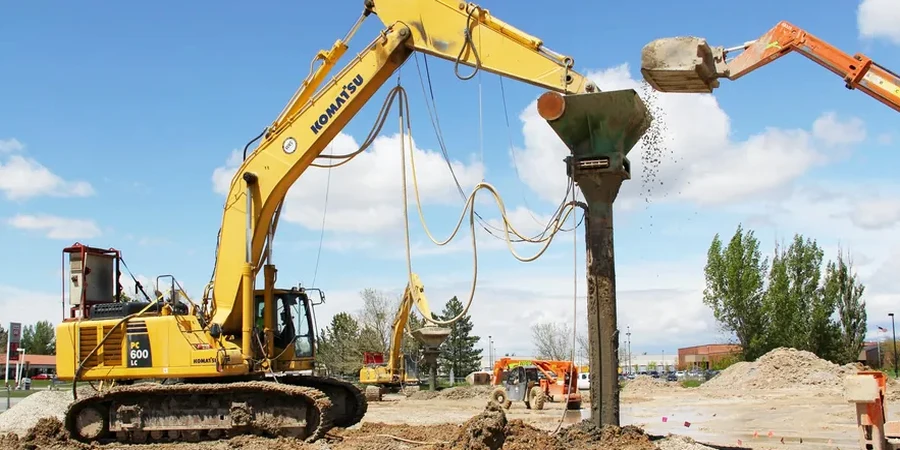
AS 1726:2017 sets the standard for site investigations across Australia, and in Mildura the ground conditions make this code especially relevant. The city sits on the Murray Basin's deep alluvial deposits: layered sands, silts, and occasional clay lenses deposited by the river system over millennia. For structures founded on these soils, loose granular layers pose a real settlement and liquefaction risk. Vibrocompaction design provides a proven solution. Our team applies the methodology outlined in AS 4678 to deliver densification schemes that increase relative density well above 70%, transforming loose sands into competent bearing strata. For sites where the sand fraction is clean and the water table is accessible, the technique is both cost-effective and fast, reducing the need for deep piling. Before committing to a full program, we often combine the design with a targeted CPT test campaign to map the in-situ state parameter and confirm the depth of influence achievable with the vibrator.
A well-designed vibrocompaction grid can increase relative density from 40% to over 80% in Mildura's alluvial sands, eliminating the need for deep foundations.
Local considerations
Mildura's growth as a regional hub has pushed development onto land that, historically, was considered marginal for heavy construction: old river channels, floodplain terraces, and areas with uncontrolled fill from decades of agricultural use. The 1956 Murray River floods deposited significant sediment across the district, and many commercial lots along Fifteenth Street and the industrial precincts near the river sit on loose, saturated sands that are susceptible to both static settlement and cyclic mobility during seismic events. While Victoria's seismic hazard is moderate compared to other states, AS 1170.4 still requires consideration of site class. Loose sand defaults to Site Class Ce or De, which amplifies spectral acceleration and increases design loads. A properly executed vibrocompaction design shifts the site to Class C or better, reducing the seismic demand on the structure. The alternative — excavating and replacing the loose material — is often impractical at depths beyond 3 metres, especially with the high groundwater table common in the Mildura region.
Frequently asked questions
What type of soil in Mildura responds best to vibrocompaction?
Clean, cohesionless sands with a fines content below 10% give the best results. The alluvial deposits of the Murray Basin often meet this criterion, but we always run a grain size analysis and Atterberg limits test first. If the silt or clay fraction is too high, the technique loses efficiency and other methods should be considered.
How is the design verified after treatment?
We use cone penetration testing (CPT) as the primary verification tool because it provides a continuous profile of tip resistance and sleeve friction. A series of soundings is performed at the centroid of the compaction grid, and the results are compared directly against pre-treatment data. SPT tests can also be used where CPT access is limited. The acceptance criterion is typically a minimum cone resistance of 10 to 15 MPa over the treated depth, depending on the project specification.
What depth can vibrocompaction reach in Mildura's ground conditions?
With standard electric or hydraulic vibrators in the 130-180 kW range, we routinely achieve effective treatment to 12-15 metres depth. The limiting factor is usually the groundwater table and the presence of any dense, pre-compacted layers. In Mildura's alluvial profile, the water table is often within 2-4 metres of the surface, which actually helps the process by reducing effective stress during vibration.
What is the typical cost range for vibrocompaction design in Mildura?
For a complete design package including feasibility review, test panel supervision, production design, and QA/QC reporting, the cost typically ranges between AU$2,390 and AU$7,940 depending on site size, depth of treatment, and the number of verification soundings required. We provide a fixed-fee proposal after reviewing the geotechnical data.