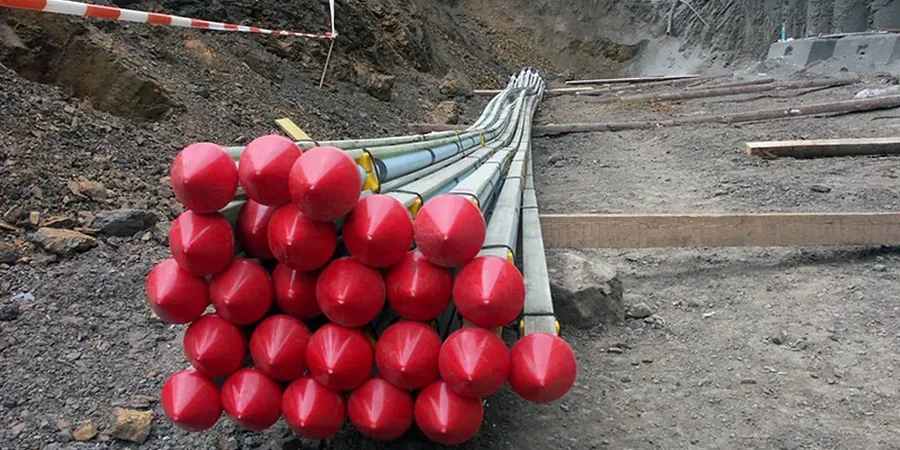
We regularly review designs in Mildura that treat anchors as a standard catalogue item, ignoring the extreme reactivity of the local clay profile. A passive anchor embedded in the Pliocene Parilla Sand performs completely differently than one socketed into the overlying Blanchetown Clay, and overlooking this distinction leads to creep deformation or progressive anchor pull-out after the first wetting cycle. The Mildura region, sitting on the Murray Basin sediments with a semi-arid climate averaging less than 300 mm of rainfall per year, experiences significant soil moisture fluctuation that directly governs the long-term bond stress in both active and passive ground anchors. Our team correlates site-specific suction profiles from undisturbed tube samples with Atterberg limits testing to calibrate the anchor bond length, ensuring that the design accounts for the characteristic shrinkage-swelling cycles of the local reactive clays rather than relying solely on conservative empirical values from the AS 4678-2002 code.
Anchor design in Mildura must separate the free length from the reactive near-surface zone: 4.5 metres minimum unbonded length through seasonal shrinkage clay prevents load transfer degradation.
Our approach and scope
With a population approaching 34,000 and serving as the agricultural hub of the Sunraysia district, Mildura has seen considerable growth in industrial warehousing and riverfront developments that demand deep excavation support. The design of active anchors for soldier pile walls along the Murray River floodplain requires careful evaluation of the groundwater regime, as the water table can rise substantially during regulated high-flow releases from the upstream dams. In our experience, the ultimate bond stress derived from pressuremeter tests in the semi-consolidated Parilla Sand typically falls between 150 kPa and 300 kPa, depending on the degree of cementation and the presence of iron oxide staining. We specify post-tensioning procedures that include a lock-off load at 110% of the design working load and performance testing on at least 1 in 10 anchors per AS 4678, with extended creep monitoring when the installation intersects zones of high plasticity clay with a liquidity index below 0.4. The tendon free length through the active zone of seasonal moisture change is never less than 4.5 metres in Mildura’s reactive soil profile to prevent load transfer into the shrinking near-surface stratum.
Regulatory framework
AS 4678-2002 Earth-retaining structures, AS 1726-2017 Geotechnical site investigations, AS/NZS 1170.0:2002 Structural design actions – General principles, AS/NZS 1170.4:2007 Earthquake actions in Australia, AS 1289/A416M-18 Standard specification for low-relaxation, seven-wire steel strand for prestressed concrete
Quick answers
What is the difference between active and passive anchors, and which one is right for a Mildura basement excavation?
Active anchors are prestressed after installation to actively apply a compressive load to the retained ground, which limits wall deflection and is essential for deep excavations adjacent to existing structures. Passive anchors, often called soil nails, develop their resisting force only when the ground begins to deform, making them suitable for slope stabilisation or lower-risk cuts. In Mildura’s reactive clays, we typically specify active anchors for basement shoring deeper than 3 metres because the prestress counteracts the immediate lateral stress relief when the excavation opens, and the controlled lock-off force prevents the wall from moving into the excavation as the clay at the surface begins its seasonal shrinkage cycle.
How much does an anchor design and testing package cost in Mildura?
What site investigation data is needed before an anchor design can proceed in Mildura?
At minimum, we require a geotechnical investigation that includes boreholes with SPT data to the full anchor bond depth plus 3 metres, undisturbed tube samples for laboratory shear strength testing, and a groundwater monitoring record over at least one seasonal cycle. For permanent anchors, we strongly recommend pressuremeter tests in the Parilla Sand to derive the in-situ modulus and limit pressure, which directly inform the bond stress selection. Without this data, the designer must rely on conservative empirical correlations that may result in anchor lengths 30-50% longer than necessary, increasing cost and installation time unnecessarily.
How is corrosion protection addressed for permanent anchors in Mildura's soil conditions?
Permanent anchors in Mildura must be protected to Class II encapsulation as a minimum per AS 4678, which requires a corrugated plastic duct filled with cement grout surrounding the tendon over the entire free length, and a grout cover of at least 20 mm over the bond length. The local Blanchetown Clay has moderate electrical resistivity and a pH that can drop below 5.5 in oxidised zones, creating a mildly aggressive environment. We specify fully encapsulated anchor heads with a protective cap filled with corrosion-inhibiting grease, and for anchors near the Murray River where sulfate concentrations are elevated, we use sulfate-resistant cement in the grout mix.
How long does the anchor design and approval process take for a Mildura project?
The design phase for a typical anchored wall in Mildura takes two to three weeks from receipt of the complete geotechnical data, including the preparation of anchor schedules, capacity calculations, and construction specifications. The independent review and building permit approval through the Mildura Rural City Council typically adds another two to four weeks, depending on the project complexity and the current workload of the reviewing engineer. We manage the submission and respond to any requests for information to keep the process moving, and we can accommodate accelerated timelines for urgent projects when agreed in advance.