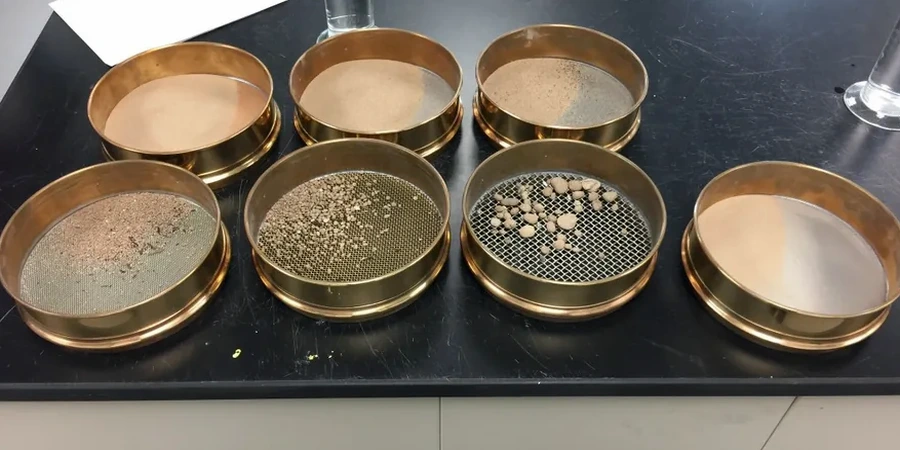
Mildura sits on the Quaternary alluvial deposits of the Murray River floodplain at about 50 metres elevation, where sediment layers shift from coarse channel sands to backswamp clays within a few hundred metres. Getting the particle size distribution wrong here means misclassifying the soil entirely. Our grain size analysis combines wet sieving through the full stack from 75 mm down to 75 microns with a hydrometer sedimentation run for the fines fraction, all following AS 1289.3.6.1. The combined curve gives you exact percentages of gravel, sand, silt, and clay. For projects near the riverbanks where lenses of poorly graded sand sit alongside fat clay layers, this dual method catches the full picture. We tie the results into the Unified Soil Classification System so your geotechnical report reads clean and defensible. Before placing footings on the older Blanchetown Clay that surfaces west of town, many engineers run a triaxial test on undisturbed samples to confirm shear strength parameters once the grading confirms the material type.
A complete sieve-plus-hydrometer curve reveals the difference between a well-graded sand and a gap-graded silty sand that can liquefy under vibration.
Local considerations
The Murray Basin sediments underlying Mildura include extensive deposits of Blanchetown Clay, a stiff but sometimes dispersive material that can erode internally when water moves through it. A grain size curve that shows more than 30 percent clay fraction and low sand content is a red flag for piping susceptibility. The real risk shows up in stormwater basins and irrigation channels where seepage forces act on the soil skeleton. Without the hydrometer data, a simple sieve-only test misses the clay fraction entirely and the soil gets logged as silt, which carries none of the same warnings. On the other side of the grading spectrum, clean sands with a uniformity coefficient below 3 and a D10 around 0.15 mm are prone to internal instability. For pipeline trench backfill in these materials, the gradation determines whether a filter fabric or a graded granular filter is needed. We flag these issues directly in the lab report rather than leaving them buried in a spreadsheet.
Frequently asked questions
What does a grain size analysis cost in Mildura?
A combined sieve and hydrometer test typically runs between AU$160 and AU$300 per sample, depending on the number of sieve sizes requested and whether the hydrometer run is included. Samples with high fines content that require longer sedimentation readings sit at the upper end of the range.
How long does the hydrometer part of the test take?
The hydrometer sedimentation test runs over a minimum 24-hour period, with readings taken at 0.5, 1, 2, 5, 15, 30, 60, 240, and 1440 minutes after mixing. Oven drying and sieve shaking of the coarse fraction adds another few hours, so a full combined analysis typically reports within two to three working days.
When is a hydrometer test required instead of just a sieve analysis?
AS 1726 and most project specifications require a hydrometer test when more than 12 percent of the sample passes the 75 µm sieve. The hydrometer is essential for distinguishing silt from clay, which has major implications for shrink-swell behaviour, permeability, and dispersivity in Mildura’s Murray Basin soils.
Can you test samples containing gypsum or calcrete?
Yes, though oven drying temperature is held strictly at 60°C rather than the standard 105°C for samples with significant gypsum content, to avoid driving off crystalline water. Calcrete nodules common in the Mildura area are crushed and included in the coarse fraction, and we note their presence on the report as they can influence the engineering interpretation of the grading curve.