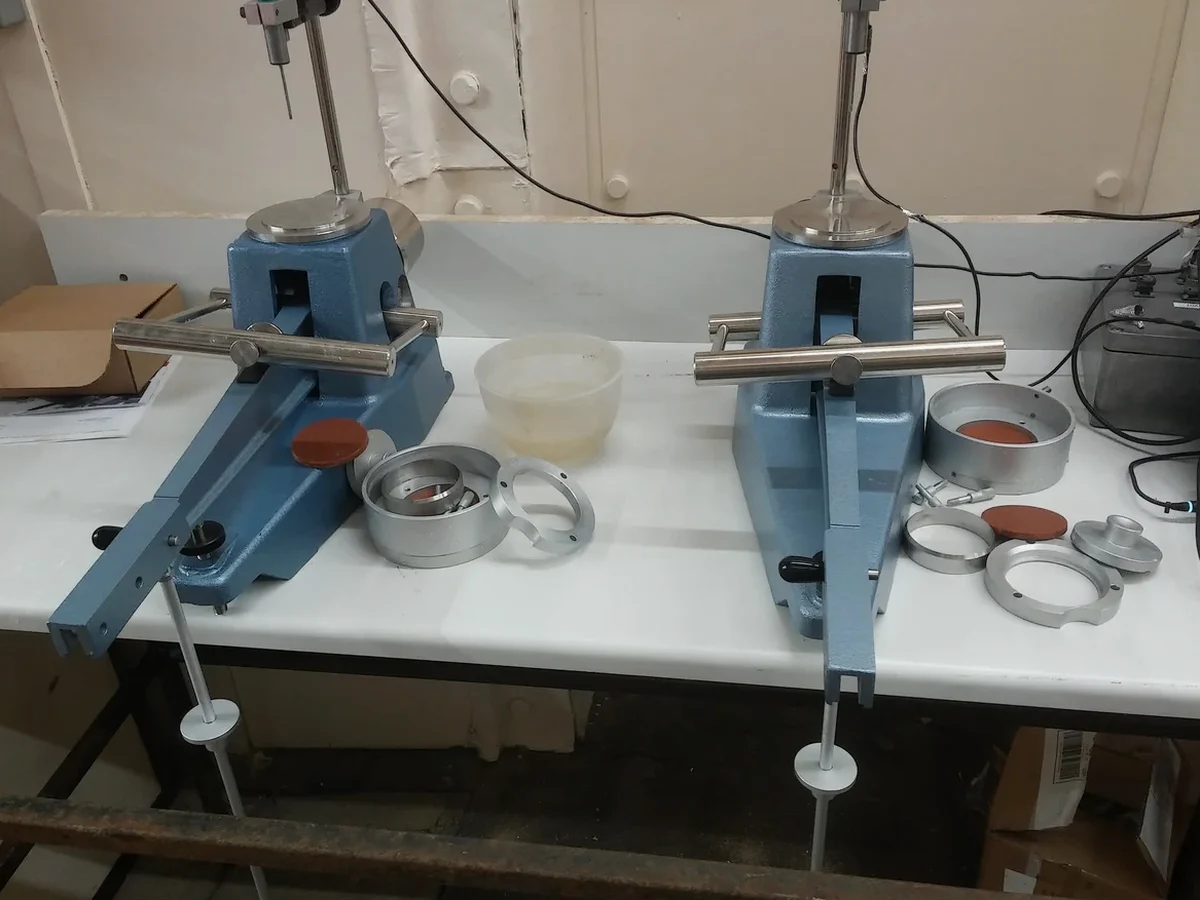
The Murray River floodplain around Mildura deposits thick sequences of clay-rich alluvium that can change from stiff to soft within a single borehole log. Liquid limits above 60 percent are common in the reddish-brown clay facies west of the city centre, and plasticity indices exceeding 30 create real challenges for shallow footing design. Our laboratory runs the Casagrande cup method and the thread-rolling test under AS 1289.3.1.1 and AS 1289.3.2.1 to give you the liquid limit, plastic limit, and derived plasticity index numbers that go straight into site classification tables. When the clay fraction dominates, we often combine Atterberg determination with a particle size distribution to distinguish silt from clay reactivity, which matters enormously for shrink-swell assessment in Mildura's semi-arid climate.
When the plasticity index crosses 25 percent in Mildura's alluvial clays, foundation movement becomes a design-governing parameter, not a footnote.
Site-specific factors
Sites in the Nichols Point horticultural area behave differently from those on the sandy rises near the Mildura airport. The former sit on thick smectite-rich clay with plasticity indices routinely above 30 percent, while the latter often contain enough fine sand to bring the PI below 15 percent — a difference that shifts the site classification from H2 to M under AS 2870. Getting the Atterberg limits wrong on a high-PI clay means the structural designer either over-designs the footing and wastes concrete, or under-designs it and inherits a cracking problem within the first two dry summers. We have seen bore logs where a single metre of vertical change dropped the liquid limit from 68 to 41 percent, completely altering the reactivity depth profile. For any earthworks compaction specification, the plastic limit is also the moisture content target that gives optimum workability, so skipping this test makes density control guesswork.
Quick answers
What do the Atterberg limits tell me about my Mildura site?
They quantify the moisture contents at which the fine-grained soil changes from a brittle solid to a plastic material (plastic limit) and from plastic to a viscous liquid (liquid limit). The difference — the plasticity index — is the key input for AS 2870 reactivity classification. In Mildura's alluvial clays, a PI above 25 percent typically signals a highly reactive site that needs a stiffened raft or deep footing design.
How much sample do you need for Atterberg limits testing?
About 300 grams of air-dried soil passing the 2.36 mm sieve is enough for the liquid limit, plastic limit, and linear shrinkage combined. If you also want a companion particle size analysis, we prefer 500 grams. The sample must be bagged to preserve its natural moisture content if we are also running a field moisture determination.
What is the cost of Atterberg limits testing in Mildura?
Can you run Atterberg limits on the same sample used for a Proctor test?
Yes, and we often do exactly that for earthworks projects. The Proctor compaction test uses material passing the 19 mm or 37.5 mm sieve, and we split a sub-sample from the same bulk bag at the 425-micrometre sieve for Atterberg determination. This gives a complete picture of the fill material: its compaction curve plus its plasticity-driven workability range.
How long does the test take from sample drop-off to report?
Routine turnaround is three to five working days. The oven-drying step alone takes 24 hours, and the liquid limit test requires careful blow-count plotting. If the project is on a critical path we can deliver a preliminary result — liquid limit and plastic limit without the full QA review — within 48 hours, with the NATA-endorsed final report following the next day.