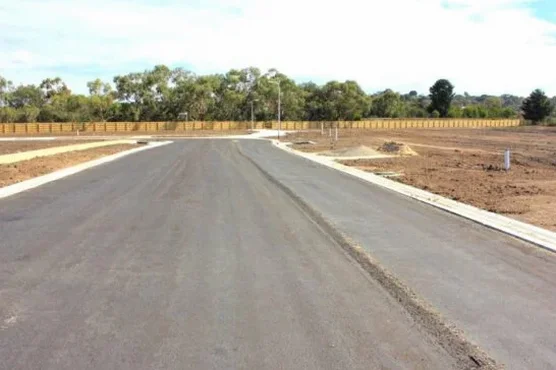
One of the most common mistakes we see in Mildura is treating a concrete pavement like it's just a thicker version of asphalt. The local grey and red cracking clays across the Sunraysia district will heave and shrink with moisture changes, and if your rigid pavement design does not account for that movement, you will get mid-slab cracks within the first two summers. We run actual subgrade CBR and Atterberg limits on samples taken from your site, not generic regional values, and then model the slab thickness, joint spacing, and load transfer. For projects with deep clay profiles, we often recommend a test pits investigation first to see exactly where the reactive zone sits before locking in the concrete specification. With proper rigid pavement design, the slab works as a structural plate, distributing loads from forklifts, trucks, or agricultural machinery across a wider footprint so the underlying soil never sees stress beyond its capacity.
A rigid pavement is a structural slab. If the soil moves, the concrete cracks. In Mildura's reactive clays, we design for the movement, not against it.
Local considerations
Mildura sits on Quaternary alluvial clays and silts along the Murray River floodplain, with isolated sand dunes to the south. The biggest geotechnical risk for rigid pavement design here is differential heave. You will have one end of a warehouse slab on dry, compacted dune sand and the other end on reactive grey clay that swells 40 mm or more when the irrigation season starts or a leaking pipe saturates the ground. Without a site-specific rigid pavement design, that slab will fault at the joints and the cracks will telegraph right through any floor covering. We have also seen projects where the contractor skipped the subbase drain and the water ponded under the slab, softening the clay and dropping the k-value to almost nothing. Our lab quantifies these risks upfront with soil reactivity tests and a desktop pavement model so the slab thickness and reinforcement are matched to actual site conditions, not a textbook assumption.
Applicable standards
Austroads Guide to Pavement Technology Part 2: Pavement Structural Design, AS 3727.1:2016 – Guide to residential pavements, AS 1289 – Methods of testing soils for engineering purposes (subgrade CBR, Atterberg limits, compaction), AS 1012.11 – Methods of testing concrete – Determination of the modulus of rupture, AS 5100 – Bridge design (approach slab provisions)
Frequently asked questions
How much does a rigid pavement design package cost in Mildura?
For a typical rigid pavement design project in Mildura — including site investigation, laboratory testing, and the design report — the cost ranges from AU$2,910 to AU$9,080. The final figure depends on the slab area, number of boreholes or test pits required, and whether construction-phase testing is included in the scope.
When is rigid pavement better than flexible pavement for Mildura soil?
Rigid pavement makes sense when you have heavy, concentrated loads — forklifts, truck docking areas, grain silo aprons — or when you want a long-life surface with minimal maintenance. In Mildura's reactive clays, a well-designed concrete slab also bridges small soft spots that would rut an asphalt pavement within a few seasons.
What depth of subgrade investigation do you need for a rigid pavement?
We typically investigate to at least 2.0 metres below the proposed slab level, and deeper if the preliminary logs show very soft or highly reactive clay continuing at that depth. The goal is to capture the full depth of seasonal moisture change so we can design the slab and subbase to accommodate that movement.
Do you design residential concrete driveways as well as industrial pavements?
Yes, we design rigid pavements for residential driveways, shed slabs, and rural home garages across Mildura and the surrounding Mallee. The design follows AS 3727 for residential applications, with adjustments for local soil reactivity. A residential design still includes a soil test, slab thickness check, and reinforcement specification.
What concrete strength do you specify for a rigid pavement in Mildura?
The concrete flexural strength we specify depends on the traffic loading and subgrade support. For most industrial pavements, we target a characteristic flexural strength (f'cf) of 4.5 MPa at 28 days, tested per AS 1012.11. Heavy-duty container pavements may require 5.0 MPa or higher. We always match the strength grade to the fatigue analysis in the design model, not a generic recipe.