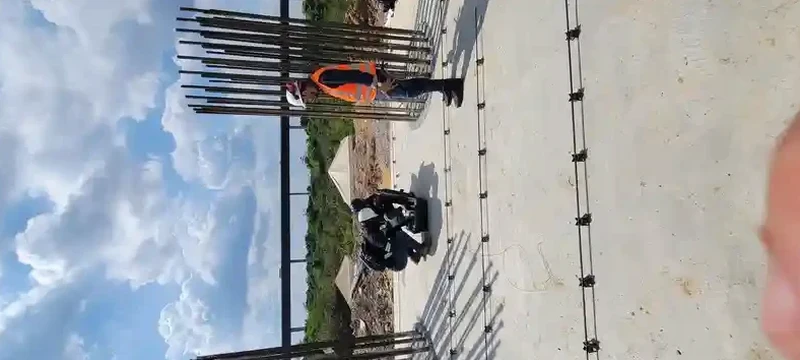
Mildura's expansion across the Murray River floodplain has pushed development onto Quaternary alluvium and clayey sand deposits that vary dramatically in stiffness within a single building footprint. Early subdivisions near the riverfront encountered soft lenses at five metres depth that conventional boreholes missed entirely, prompting local geotechnical engineers to adopt surface wave methods as a routine complement to invasive drilling. We run active and passive MASW arrays across residential lots, commercial pads, and solar farm sites to deliver VS30 profiles that meet AS 1170.4 site classification requirements. For deeper investigations beyond 20 metres where the Parilla Sand formation controls seismic response, we combine the MASW survey with a seismic refraction line to constrain velocity inversions that Rayleigh wave methods alone can misinterpret.
A single MASW line replaces three to five boreholes for seismic site classification, cutting field time by sixty percent while delivering the continuous VS profile that AS 1170.4 requires.
Quick answers
How much does a MASW survey cost for a standard residential lot in Mildura?
What is the difference between active and passive MASW, and why do you use both?
Active MASW uses a sledgehammer or weight-drop source and a short geophone spread to resolve shear wave velocity in the upper ten to fifteen metres with high resolution. Passive MASW records ambient noise and microtremors using a wider sensor array, extracting the low-frequency dispersion curve needed to profile down to thirty or forty metres. Combining both methods gives a continuous VS profile from one metre to full depth, which is essential when soft Blanchetown Clay near the surface overlies stiffer Parilla Sand: the active method captures the shallow contrast, and the passive method reaches the deeper competent material that governs the site period.
How does AS 1170.4 use VS30 for earthquake design in Mildura?
AS 1170.4-2007 classifies sites into five classes (A through E) based on the average shear wave velocity in the top thirty metres. VS30 determines the site factor that scales the design response spectrum for structural analysis. In Mildura, where earthquake hazard is low to moderate, most sites fall into class C or D depending on the thickness and stiffness of the near-surface alluvium. A correctly measured VS30 ensures the structural engineer does not over-design for an unnecessarily stiff site class or under-design by assuming softer conditions than exist.
Can MASW replace boreholes entirely for a geotechnical investigation?
MASW replaces boreholes for seismic site classification and VS30 determination, but it does not provide the physical soil samples needed for laboratory strength testing or visual logging of stratigraphy. In Mildura practice, we typically recommend one or two boreholes with SPT sampling combined with a MASW line to cover the full investigation scope: the boreholes calibrate the velocity model to known stratigraphy, and the MASW line extends the seismic profile across the site at a fraction of the cost of additional drilling.