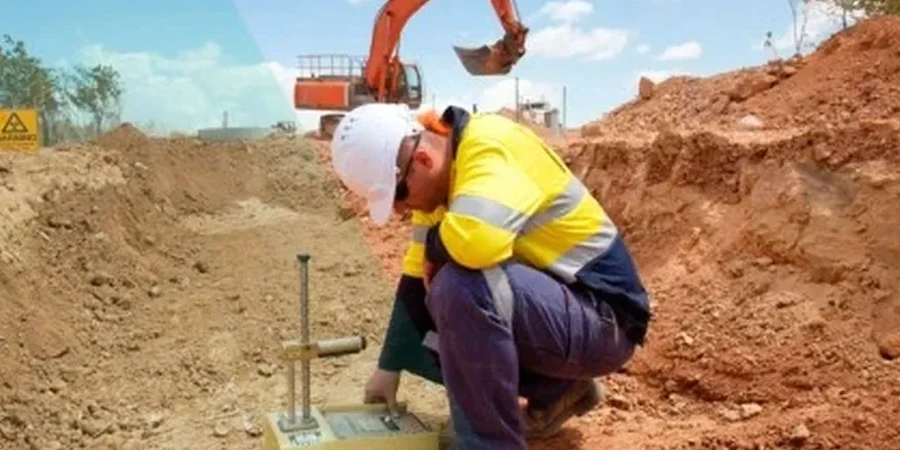
AS/NZS 1170.4 requires site-specific hazard assessment when ground conditions suggest amplification could change the design spectrum, and that is exactly the scenario across much of Mildura. The city sits on deep Tertiary and Quaternary sediments of the Murray Basin, where soft alluvial clays and sands overlie the Renmark Group at variable depth. The contrast between stiff aeolian dunes near the river and the floodplain deposits creates a patchwork of site classes that a generic code approach cannot capture. For projects along Fifteenth Street or near the riverfront, we run non-invasive shear wave velocity profiling and combine it with borehole data to build reliable one-dimensional site response models. The result is a design ground motion that reflects Mildura conditions rather than a distant rock reference, which often reduces unnecessary conservatism in foundation design.
The Parilla Sand impedance contrast beneath Mildura can amplify ground motion at periods that matter most for low-rise commercial buildings.
Quick answers
Is seismic microzonation mandatory for building projects in Mildura?
Not always mandatory, but AS/NZS 1170.4 requires site-specific studies when ground conditions indicate that site amplification could significantly alter the design spectrum. In Mildura, where deep sediments and paleochannels create variable site classes across short distances, a microzonation study provides the measured evidence to justify the design spectrum and often reduces conservatism compared to default assumptions.
What is the typical cost range for a seismic microzonation study in Mildura?
How long does a microzonation study take from start to finish?
Fieldwork for MASW and downhole seismic testing at a typical Mildura site takes one to two days. Processing, modelling, and reporting add another two to three weeks, assuming existing borehole logs are available. If additional drilling or CPT soundings are needed to constrain the velocity model, the timeline extends by the drilling schedule, which can vary with rig availability in the Sunraysia region.
Can you use existing borehole data for the site response model?
Existing borehole logs are valuable, but they rarely provide shear wave velocity data needed for site response analysis. We use them to constrain layer boundaries and soil types, then overlay MASW or downhole seismic results to assign velocity to each layer. The combination of borehole stratigraphy and geophysical measurements produces a much more reliable model than either dataset alone.