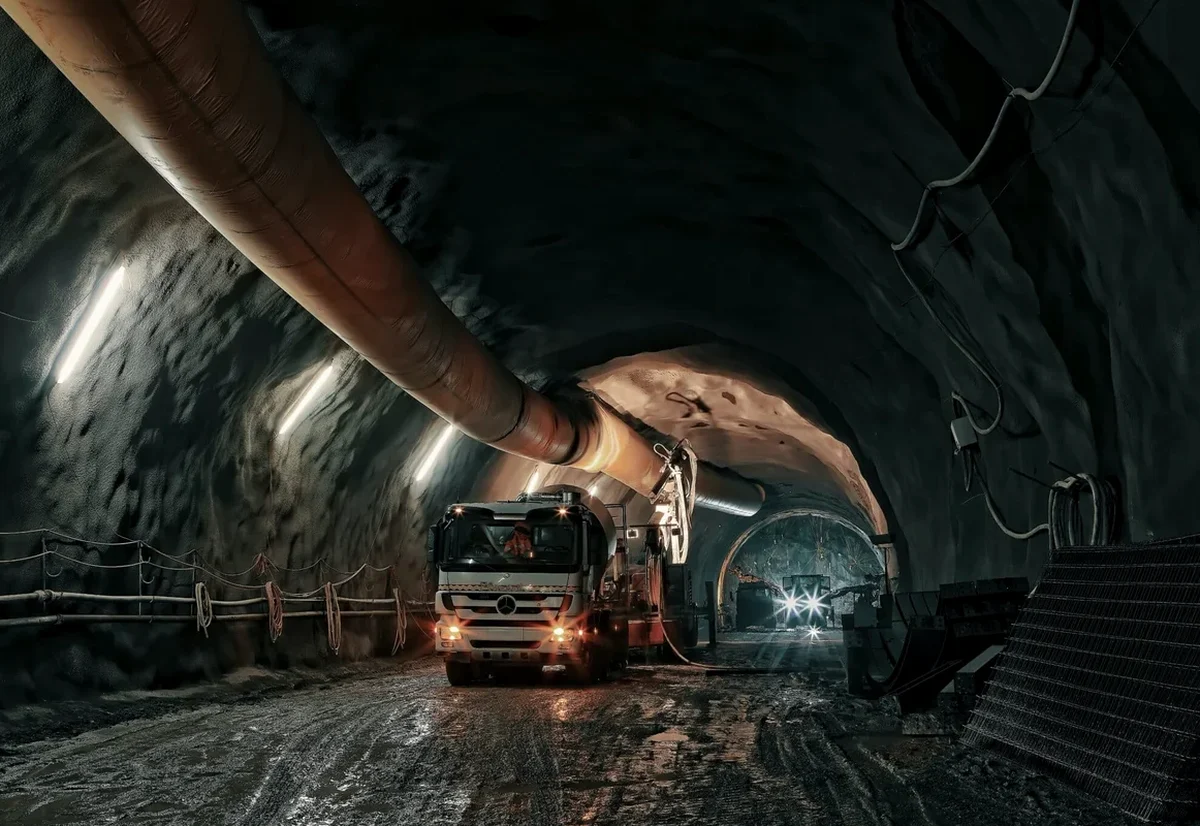
The hollow-stem auger bites into the reddish-brown clay of Mildura's riverine flats, pulling up a sample that tells the story of a thousand floods. Soft soil tunneling here is a different beast to the rock drives in the eastern states. We run a comprehensive suite of index and strength tests on every bore because the Murray Basin sediments change character every few hundred metres. A triaxial consolidated-undrained test with pore pressure measurement gives us the effective stress parameters for tunnel face stability, while in-situ permeability testing in the sandy lenses interspersed within the clay matrix determines the dewatering strategy before anyone puts a cutting head in the ground. The lab here processes undisturbed Shelby tube samples from depths of 6 to 25 metres within 24 hours of extraction to preserve natural moisture content.
In Mildura's floodplain clays, the difference between a successful tunnel drive and a face collapse is often a 2-metre sand lens no one tested.
Our approach and scope
AS 1726:2017 governs the geotechnical site investigation methodology, and for good reason in Mildura. The city sits on Quaternary alluvial deposits of the Murray River system, where paleochannels filled with loose, saturated sand lie hidden beneath a stiff clay crust. Our logging follows the AS 1726 classification framework rigorously: consistency, moisture condition, and minor geological details that a generic investigation misses. The undisturbed sampling protocol for soft ground demands thin-walled tubes pushed at a constant rate of penetration, not hammered. We pair this with pocket penetrometer readings and torvane shear strength estimates at 200 mm intervals along the core. For tunnel alignment design, the key numbers come from the oedometer consolidation test and the undrained shear strength profile. A single mischaracterized layer of soft, normally consolidated clay at tunnel invert level can lead to face extrusion and surface settlement troughs extending well beyond the right-of-way.
Site-specific factors
The classic mistake in Mildura is treating the stiff surficial clay as representative of the entire tunnel horizon. A local contractor once advanced a microtunnel boring machine assuming firm ground based on the first three metres of the bore log; the machine nosedived when it hit a saturated paleochannel sand at five metres depth, flooding the pit and delaying the project by eight weeks. Soft ground tunneling demands a continuous profile of strength and stiffness. Without consolidation data, the predicted surface settlement can be off by a factor of three. In the Murray River floodplain, the groundwater table fluctuates seasonally, and a tunnel alignment designed with dry-season pore pressures may face buoyancy issues and reduced effective stress during a wet winter. The NATA-accredited laboratory runs every consolidation stage to 24 hours minimum per increment, because rushing the secondary compression phase in high-plasticity Mildura clays masks the true long-term settlement behaviour.
Quick answers
What is the typical depth range for soft soil tunnel investigations in Mildura?
Most tunnel alignments in Mildura sit between 6 and 25 metres below surface, within the Quaternary Murray Basin sediments. Boreholes are typically advanced to at least 1.5 times the tunnel diameter below invert level, with undisturbed sampling concentrated in the tunnel horizon and the zone of influence above the crown.
How long does a complete soft soil tunnel investigation take?
Fieldwork for a linear alignment of 500 to 1000 metres typically runs 10 to 15 working days. Laboratory testing on the undisturbed samples – triaxial, oedometer, index tests – requires an additional 4 to 6 weeks due to the consolidation stages. Rush testing can be arranged, but consolidation timeframes are governed by soil permeability, not lab capacity.
Do you provide parameters for numerical modeling like PLAXIS or FLAC?
Yes. The laboratory program is designed to output the full parameter set for advanced constitutive models: Hardening Soil, Soft Soil, and Soft Soil Creep. This includes λ*, κ*, φ', c', ψ, and permeability anisotropy ratios derived from vertical and horizontal oedometer specimens.
What does a soft soil tunnel investigation cost for a typical Mildura project?