Mildura sits on the Murray River floodplain, where surface soils are dominated by Quaternary alluvial silts and fine sands deposited over ancient Blanchetown Clay. The upper 300 to 600 millimetres often contain loosely packed layers that shift dramatically with moisture, making compaction verification a non-negotiable step before any slab pour. A structural fill that passes visual inspection can still fail under load if the dry density ratio is even two percent below specification. On a recent warehouse pad near the Mildura Airport, we recorded post-placement readings of 92 percent Standard Proctor in one corner while the rest of the pad held at 98 percent. That single outlier, traced to a lift that dried out faster in the north-westerly wind, would have been missed entirely without systematic sand cone density testing. The sand cone method described in AS 1289.5.3.1 remains the most practical direct-measurement field test for granular and fine-grained fills when nuclear gauge licensing or cost is a constraint, and our laboratory brings the full kit to sites from Irymple to Red Cliffs within a day's notice.
A density reading of 98 percent on one corner means nothing if the opposite corner reads 91, and in Mildura's layered floodplain silts, that spread is more common than most contractors expect.
Methodology and scope
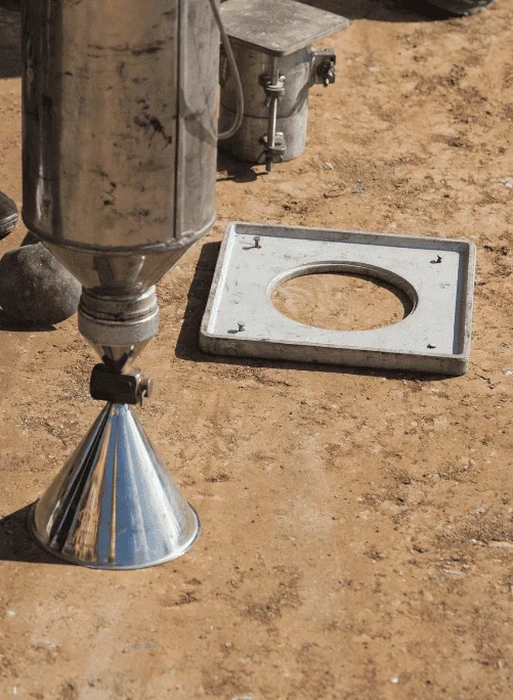
The field kit begins with a calibrated one-gallon sand jar mounted above a base plate with a 165-millimetre circular opening. We fill the jar with uniformly graded Ottawa sand that has been through at least three bulk density calibrations against our in-house reference cylinder, traceable to NATA-endorsed mass standards. On site in Mildura, the technician digs a test hole to the full depth of the compacted lift, typically 150 to 200 millimetres, using a spoon auger when the fill contains scattered river gravel. All excavated material goes straight into a sealed bag for moisture content determination back at the lab. The sand is then released from the cone valve until it fills the hole and the funnel, and the mass difference directly yields the in-place volume. That volume, paired with the oven-dried mass, gives the wet density, which is corrected for moisture using a separate sample dried at 105 degrees Celsius. On larger earthworks projects where the fill source varies, we often pair the sand cone with a
Proctor test to establish the target maximum dry density and optimum moisture content for that specific borrow material. For sites where the fill sits over natural clay that may soften under repeated loading, a
CBR evaluation run on the same subgrade layer helps the pavement designer confirm the design modulus before basecourse placement begins.
Local considerations
A 14-unit townhouse development on Benetook Avenue had footings designed for a 100 kPa bearing pressure, with the structural engineer specifying 95 percent modified Proctor compaction on all controlled fill beneath the raft slab. During pre-pour inspection, two density tests near the south-eastern corner returned 89 and 91 percent, while the rest of the pad was comfortably above 96. The site supervisor initially assumed equipment error, but a rapid moisture check with the Speedy meter revealed the real issue: an irrigation line leak from the adjoining property had saturated the fill over the previous weekend without anyone noticing. The sand cone method caught it because the test hole itself showed the colour change from dry tan silt to dark grey mud at about 120 millimetres depth. That one morning of testing prevented a slab that would have settled differentially within the first 18 months, cracking partition walls and binding doors. In Mildura's semi-arid climate, where summer evaporation can pull moisture from exposed fill at 8 to 10 millimetres per day, waiting until the day of the pour to verify density is a gamble that costs far more than the testing itself.
Frequently asked questions
How many sand cone tests do I need for a standard house slab in Mildura?
The number depends on the pad area and the fill variability. AS 3798 suggests a minimum of one test per 100 square metres per compacted lift, but on small residential slabs under 200 square metres we typically place three tests in a triangular grid to catch edge-to-centre variation. If the fill material changes during construction, for example switching from on-site clay to imported crushed rock, we add a test on each new material zone. The engineer of record makes the final call, and we follow the frequency stated on the project's Inspection and Test Plan.
What does sand cone field density testing cost in the Mildura area?
For sites within the Mildura urban area, individual sand cone tests typically range from AU$150 to AU$250 per test, depending on how many tests are performed in a single mobilisation and whether the Proctor reference curve already exists or needs to be developed from a bulk sample. A standard three-test residential pad visit, including travel, field work, oven-dry moisture determination, and a signed density report, usually falls in that same per-test range.
Can the sand cone method be used on coarse gravels or crushed rock basecourse?
The standard sand cone method per AS 1289.5.3.1 is reliable for soils with a maximum particle size up to about 20 millimetres. For fills containing coarse gravels or crushed rock up to 37.5 millimetres, the test hole must be larger, typically with a 200-millimetre diameter, and the calibration sand's bulk density needs to be rechecked more frequently because the larger sand particles can segregate in the jar. If the fill has significant cobble content, we shift to a water replacement method or a nuclear gauge in backscatter mode, but those situations are less common on typical Mildura subdivision earthworks.
How soon after compaction can the sand cone test be carried out, and does weather affect the result?
The test can be performed immediately after the compactor passes, there is no waiting period. Weather matters mainly through moisture loss: on a 40-degree Mildura summer day, a freshly compacted lift can lose 1 to 2 percent moisture in under an hour, which shifts the dry density reading upward artificially. We record the time of compaction and the time of testing on every report so the engineer can judge whether the moisture content at testing reflects the moisture content at compaction. If rain is forecast, we recommend testing before the storm front arrives, because a partially saturated fill will give a density ratio that does not represent the as-compacted condition.