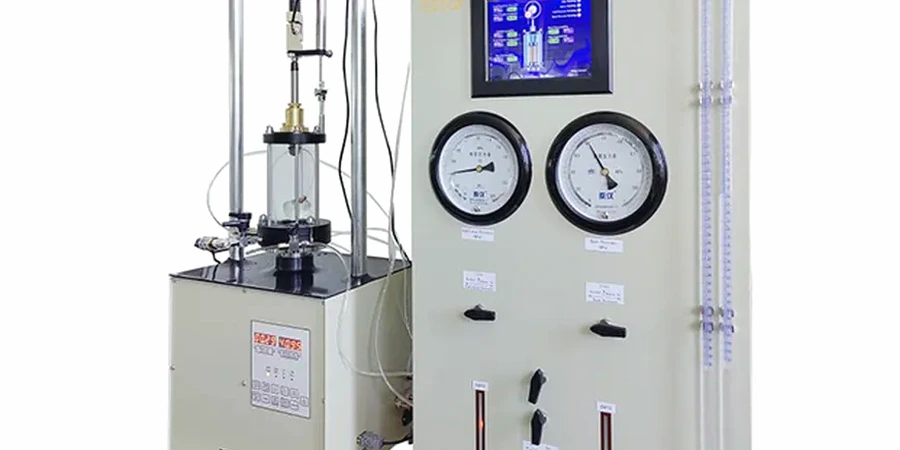
Laboratory testing forms the analytical backbone of any geotechnical investigation in Mildura, transforming field samples into quantifiable engineering parameters. This category encompasses the full spectrum of soil and rock characterisation tests performed under controlled conditions, from basic index properties to advanced strength and consolidation assessments. In a region where the Murray River and ancient geological processes have deposited complex sequences of alluvial clays, sands, and silts, the laboratory provides the certainty that field observations alone cannot deliver. For engineers and builders across Sunraysia, these tests bridge the gap between subsurface uncertainty and safe, economical design.
Mildura's geology is dominated by the Murray Basin sedimentary sequence, featuring the Blanchetown Clay, Parilla Sands, and overlying Shepparton Formation. These units exhibit significant lateral and vertical variability, with expansive clay layers, loose water-bearing sands, and cemented calcrete horizons often encountered within a single borehole. The semi-arid climate further complicates behaviour, as moisture-sensitive clays undergo pronounced shrink-swell cycles that can distress foundations and pavements. Accurate laboratory characterisation becomes non-negotiable when dealing with such reactive soils, particularly for determining parameters like Atterberg limits that directly quantify a soil's plasticity and volume change potential.
Australian testing practice in Mildura adheres to the AS 1289 series of standards, which govern methods for soil classification, compaction, strength, and chemical assessment. These norms ensure consistency and legal defensibility of results, whether the work supports a residential slab design, a major irrigation pipeline, or a road embankment. NATA-accredited laboratories, which are strongly preferred for commercial and infrastructure projects, must demonstrate compliance with ISO/IEC 17025, adding a layer of quality assurance. Local practitioners also reference Victorian-specific guidance from bodies like the Department of Transport and Planning when interpreting results for state-funded works.
The types of projects that demand comprehensive laboratory testing in Mildura are diverse. Residential developments on the city's expanding fringes require shrink-swell classification and bearing capacity inputs to satisfy AS 2870. Large-scale agricultural water storage and distribution schemes rely on permeability and compaction testing to ensure containment and structural integrity. Civil infrastructure, including bridge foundations and levee upgrades along the Murray, depends on shear strength and consolidation data. Even environmental assessments for potential acid sulfate soils necessitate specialised chemical tests. A typical scope will include a grain size analysis (sieve + hydrometer) to define the particle distribution, which underpins drainage and filter design.
Residential sites commonly need Atterberg limits to assess clay reactivity, a particle size distribution via sieve and hydrometer, and a shrink-swell index to classify the site according to AS 2870. These tests determine foundation design parameters and identify potential issues with expansive soils prevalent in the region.
Turnaround depends on test complexity and laboratory workload. Basic index tests like moisture content and Atterberg limits may be completed within three to five working days. Consolidation or triaxial strength tests, which require longer conditioning and shearing phases, can extend to two or three weeks.
NATA accreditation confirms the laboratory operates under ISO/IEC 17025, ensuring technical competence, calibrated equipment, and traceable results. For regulatory submissions, insurance requirements, or dispute resolution, NATA-endorsed reports carry legal weight and are often mandated by councils and government agencies.
Yes, a forensic testing program can diagnose causes. By comparing foundation soil properties like plasticity, moisture content, and suction profiles from distressed and stable zones, engineers can determine whether reactive clay movement, poor compaction, or moisture ingress is responsible, guiding appropriate remediation.