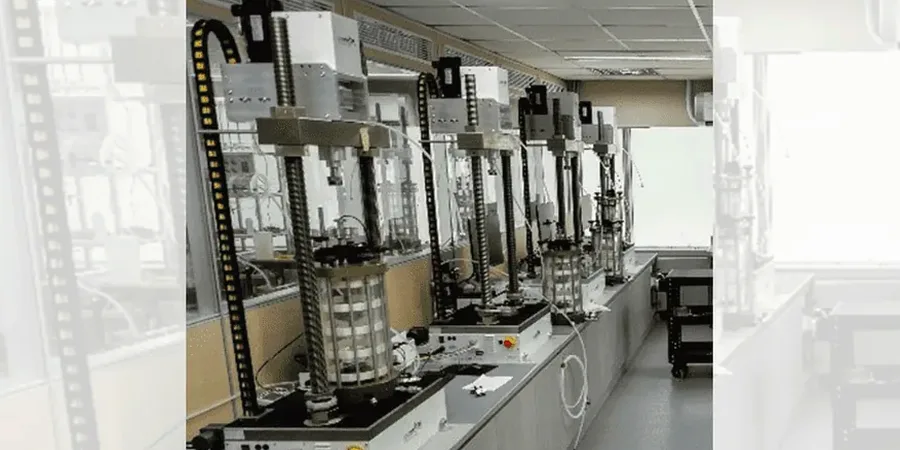
The Murray River floodplain deposits beneath Mildura create a stratigraphy where alluvial silts and sands alternate with layers of dessicated clay — a profile that demands careful shear strength characterization before any deep excavation or embankment design. With groundwater often perched within 3 to 5 metres of the surface across the Sunraysia district, effective stress parameters from a consolidated undrained triaxial test with pore pressure measurement become the only reliable input for settlement and bearing capacity calculations. In our experience working on irrigation infrastructure and commercial developments throughout the region, assuming drained behaviour without verifying the consolidation state of the Murray Group sediments has led to overly optimistic factor-of-safety values. The triaxial test, run under controlled back-pressure saturation and strain rates compliant with AS 1726, captures the stress-strain response that standard penetration testing simply cannot resolve in these transitional soils.
A consolidated undrained triaxial test with pore pressure measurement removes the guesswork from effective stress analysis in Mildura’s layered alluvial profile.
Local considerations
Mildura’s expansion since the 1950s, driven by the soldier settlement scheme and the growth of irrigated horticulture, pushed residential and industrial subdivisions onto former floodplain terraces where the near-surface clay is underlain by loose, saturated sand lenses. Without triaxial data, the undrained shear strength of these sand units is often inferred from SPT blow counts — a correlation that ignores the effect of silt content and partial saturation during the dry season. A CU triaxial program run on undisturbed samples from below the water table reveals whether these sands exhibit contractive or dilative behaviour under shear, which directly informs the liquefaction screening for pumping stations and elevated water tanks. The cost of omitting this step became evident after a 2011 irrigation basin failure near Merbein, where post-failure investigation showed the design had relied on drained parameters for a material that underwent undrained collapse during rapid filling.
Frequently asked questions
How much does a triaxial test cost in Mildura?
A standard triaxial suite (three specimens for a single Mohr-Coulomb envelope) typically ranges from AU$2,900 to AU$4,430, depending on whether undisturbed sampling, consolidation stage duration, or multi-stage shearing is required. We provide a fixed-price quote after reviewing the borehole logs and the design parameters you need.
What sample quality is required for a reliable triaxial test?
Undisturbed Shelby tube or piston samples with a recovery ratio above 90% and minimal disturbance during extrusion. For Mildura's stiff clays, thin-walled tubes driven with a smooth, continuous push yield the best results. Hand-augered block samples can also be trimmed in the lab for cohesionless materials where tube sampling causes densification.
How long does it take to get triaxial test results?
A standard CU triaxial set on three specimens is reported within 7 to 10 business days from sample receipt. Consolidated drained tests take longer — typically 12 to 15 business days — because the shearing stage must proceed slow enough to maintain zero excess pore pressure throughout the specimen.
Do I need a triaxial test if I already have SPT data?
SPT data provides an index of penetration resistance, not a direct measurement of shear strength. In Mildura's interbedded silts and clays, correlations between N-value and friction angle carry uncertainty bands of ±5 degrees or more. A triaxial test is recommended whenever the design involves a factor of safety below 1.5, deep footings, or structures sensitive to differential settlement.