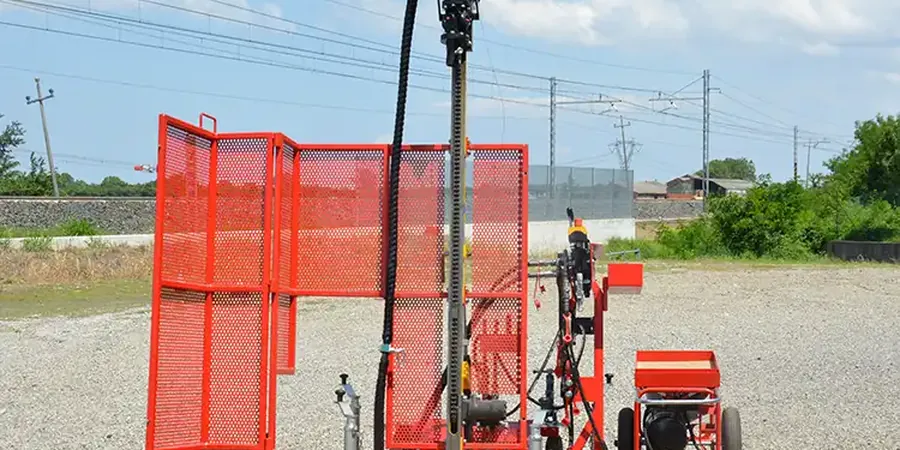
When the rig arrives on a Mildura site, the first thing we set up is the 63.5 kg automatic trip hammer—no rope-and-cathead guesswork. Mildura’s subsurface is a patchwork of Murray River alluvium, Woorinen Formation sands, and scattered calcrete lenses that can fool a novice driller. The SPT (Standard Penetration Test) gives us a repeatable number: blows per 300 mm after a 150 mm seating drive, logged as N-value at each 1.5 m interval. In the sandy loams near the river, you might see N = 8 to 15 in the upper 3 m; out toward the Red Cliffs area, we have hit refusal on cemented calcrete at less than 2 m depth, where the spoon just rings. We run the test to AS 1726.5.1, recording penetration resistance on the driller’s log in real time, and bagging the disturbed sample for visual classification back at the lab. For deeper investigation in soft floodplain clays, we often pair the SPT with a CPT test to capture continuous tip resistance and pore pressure, especially when the client needs to pick thin sand lenses that the spoon could miss.
In Mildura, an SPT refusal at 1.8 m on calcrete tells you more about the site than a dozen textbook bearing capacity equations.
Our approach and scope
The contrast between a site on Fifteenth Street, sitting on old dune sand, and one down near the riverfront on Cureton Avenue is remarkable. On the dune sand, N-values often climb steadily from 12 at 1.5 m to beyond 30 by 6 m, and the split spoon comes up with clean, slightly silty quartz sand. Down by the river, the profile is messier—interbedded clay, silt, and fine sand with N-values that can swing from 5 to 22 in less than a metre. That kind of variability is why Mildura engineers call for SPT data early in the design phase. The test provides a direct measurement of relative density in sands and a rough consistency index in clays, which feeds straight into bearing capacity calculations and settlement estimates. We wash the borehole carefully before each spoon drive to remove cuttings, and in collapsing sands below the water table—common around the Mildura Marina area—we use drilling mud to keep the hole open. When the SPT encounters refusal on a thin calcrete band, we log it and recommend a
test pit to expose the layer and check its lateral continuity, because a 200 mm crust can mislead a whole foundation design.
Site-specific factors
In Mildura, we often see builders skip the SPT because the surface looks like clean sand and the block is flat. Then the excavator hits a buried clay-filled paleochannel at 3 m, and the pad footings that were fine on paper suddenly need redesign. The SPT picks up these hidden soft spots because the N-value drops hard—sometimes from 25 to 6 over a single drill run—and the spoon comes up with grey, plastic clay that tells a story of an old Murray River meander. Another trap is assuming that calcrete refusal means you have rock. We have seen calcrete layers less than 300 mm thick floating over loose sand; the spoon refuses, but a triaxial test on an undisturbed sample from the underlying sand shows a friction angle of barely 30 degrees, which changes the entire bearing capacity model. Getting the SPT data right, with accurate depth control and proper sample recovery, prevents the kind of late-stage geotechnical surprises that burn budget and delay construction in regional Victoria.
Regulatory framework
AS 1726.5.1 — Geotechnical site investigations: Standard penetration test (SPT), AS 1726 — Geotechnical site investigations (classification, logging, reporting), AS 4678 — Earth-retaining structures (SPT data used for earth pressure and bearing capacity inputs), AS/NZS 1170.4 — Structural design actions: Earthquake actions (SPT N-values feed into site subsoil class determination), AS 1289 — Standard Test Method for SPT and Split-Barrel Sampling (referenced for international projects in the Sunraysia region)
Quick answers
What does an SPT cost on a typical Mildura residential block?
For a standard residential investigation in Mildura—usually two boreholes to 3 or 4 metres depth with SPT at each 1.5 Sites with difficult access, thick calcrete requiring rock roller bits, or the need for drilling mud in collapsing sands push toward the upper end of that range.
How many SPT boreholes do I need for a house slab in Mildura?
For a Class M or Class H slab on a standard residential lot, AS 2870 generally calls for a minimum of two boreholes, ideally positioned at opposite corners of the proposed footprint. In Mildura, where soil conditions can change sharply between the dune and floodplain zones, we often recommend three boreholes if the block is wider than 20 metres or if the site straddles two different landforms—say, part on Woorinen sand and part on river flat clay. The extra borehole is cheap insurance against missing a buried soft layer.
Can the SPT tell me if my Mildura site has a liquefaction risk?
Yes, the SPT is the most widely used field test for liquefaction screening worldwide. We take the raw N-value, correct it for overburden pressure, hammer energy, and fines content to get an N1(60) value, then run it through the simplified procedure from Youd and Idriss (2001). In Mildura, loose saturated sands in the 3 to 8 m depth range with N1(60) below about 15 blows typically warrant a closer look, especially for projects near the river where the water table sits high.